Witnessing Ottoman Studies’ recent integration of AI is exciting for the field’s development in terms of its inclusion of wider, more global audiences, the emergence of new research fields, the application of advanced technologies to archival collections, and the discovery of new materials for study. Hence, while technological innovations have been reshaping historical research and methodology, they have also added new dimensions to historiography and contributed to the development of Digital Ottoman Studies.
Observing the application of Optical Character Recognition (OCR) and Handwritten Text Recognition (HTR) techniques to Ottoman archives, it feels as though there are many more areas to explore through more archival materials and in a variety of ways. From nineteenth-century social history and longue durée approaches associated with the Annales School, to women’s and gender history and new ethnographic and anthropological approaches, and, most recently, the Digital Humanities or the application of AI in history and social sciences, not only the historical discipline itself but also Ottoman Studies has undergone significant transformation, contributing to the development of Digital Ottoman Studies. One of the latest works in this field, Digital Humanities and Ottoman Studies, is a valuable source for tracing the field’s transition from more traditional approaches to reading, transcribing, and decoding Ottoman Turkish texts to digitally assisted methods of processing and analyzing these materials. Edited by Yunus Uğur, the book covers the application of Digital Humanities methods to Ottoman Turkish texts as well as to Ottoman Studies in general. What is also important about the book is that it outlines basic techniques such as OCR, HTR, and Geographic Information System (GIS) and demonstrates their application to historical research, reflecting what has increasingly been considered a new “turn” in historical methodology (Uğur 2023a, 18).
The majority of the chapters in the edited volume were developed from papers presented at the Third International Congress on Ottoman Studies (OSARK), held at İstanbul Medeniyet University in September 2022, and they shed light on new digital technologies, such as machine learning and AI, in Ottoman Studies. As underlined in the edited volume, Digital Humanities is not simply a collection of technological tools; it also represents a broader methodological and epistemological change in how scholars produce knowledge, as historians increasingly work with structured data, interdisciplinary teams, and even artificial intelligence. However, this transformation requires international standards, collaboration, open and linked data, as well as attention to ethical issues such as privacy, bias, and unequal representation. Consequently, Digital Humanities and its subfield of Digital History require a multidisciplinary approach within Ottoman Studies in order to continue developing and to appeal to wider audiences, both within academia and beyond it (Uğur 2023a, 18-25).
Digital History, as a branch of Digital Humanities, has transformed Ottoman Studies. The field has now moved beyond the basic digitization of sources and increasingly uses advanced digital methods, such as OCR, HTR, structured databases, GIS, network analysis, visualization, linked data, and artificial intelligence, to organize and analyze the Ottoman archival records. The application of AI and other technologies to Ottoman Studies can transform the accessibility, organization, analysis, and interpretation of the Ottoman Empire’s extensive archival materials. These technologies can also generate new research questions and thus contribute not only to Digital Ottoman Studies but also to Digital History and Digital Humanities more broadly.
Digital Humanities and Ottoman Studies has ten chapters, which are divided into three sections that illustrate the use of Digital History and Digital Humanities approaches and applications for reading Ottoman Turkish texts and studying Ottoman history. The contributing authors have diverse backgrounds, ranging from history and political science to architecture and engineering. Such a multidisciplinary background also indicates that Digital Humanities is a collaborative field spanning the humanities, social sciences, and material sciences. This interdisciplinary character is also reflected in the organization of the volume. While the first part deals with Digital History and Digital Humanities, their methods, and the study of language and texts, which are crucial to Ottoman historical research, the second unit focuses on databases and network analysis. The last section, in turn, deals with spatial analysis.
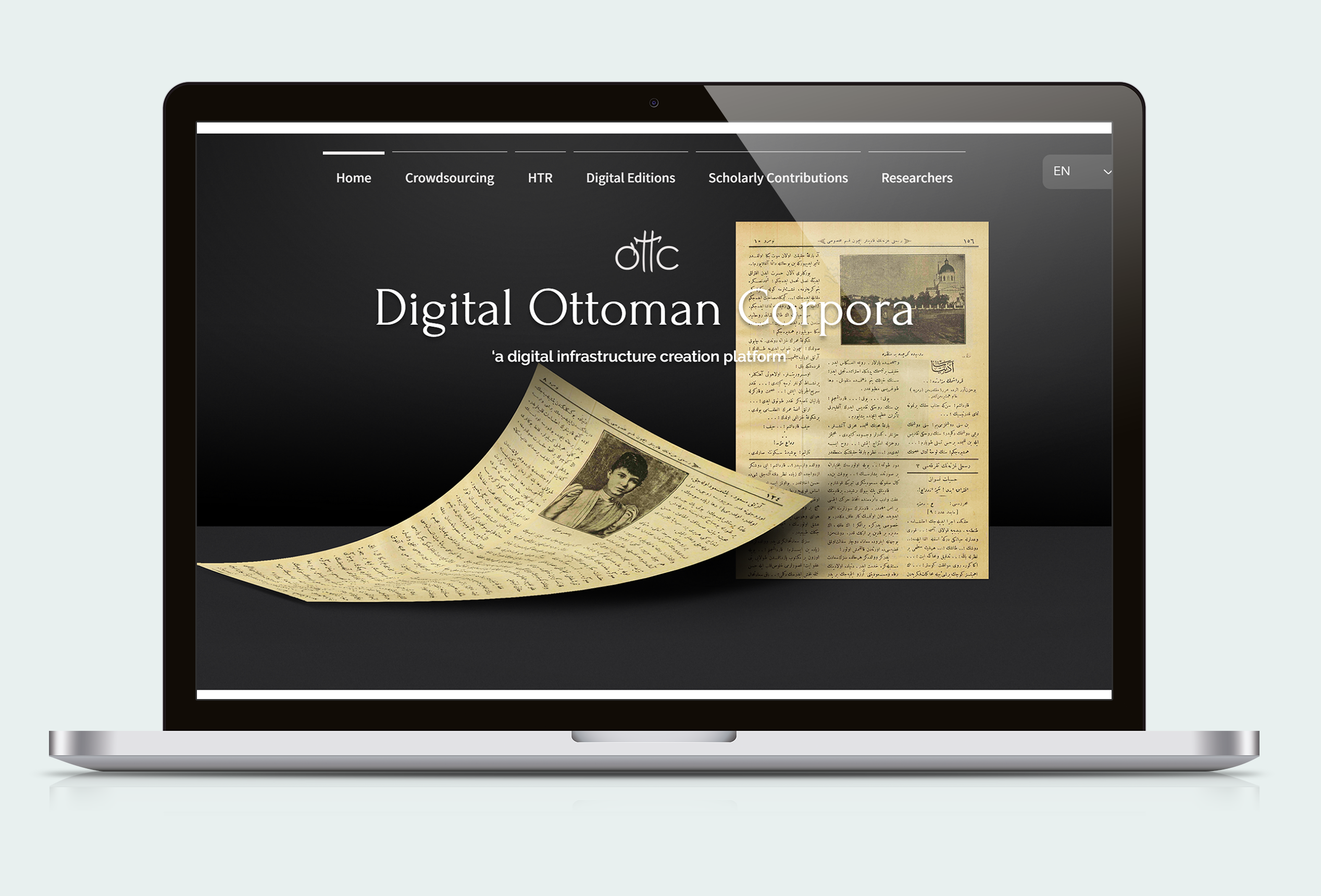
Some of the chapters in the first part include Yunus Uğur’s “Digital Humanities and Digital Ottoman Studies: A Case Study on Cultural Heritage,” which begins with an Ottoman cultural heritage project and demonstrates the ways in which Digital Humanities has contributed to it. The article examines the processes of digitization, encoding, structured data creation, analysis, and visualization (Uğur 2023b, 27-43). Fatma Aladağ and Elif Derin Can’s piece focuses on text recognition and automated transcription—OCR and HTR—and describes the general development of this work while discussing projects specifically focused on Ottoman Turkish. OCR and HTR, which were initially developed mainly by engineers using different techniques and software, have now advanced considerably thanks to the participation of historians and linguists and to developments in artificial intelligence. According to the authors’ conclusion, while progress in the automated transcription of printed texts in Ottoman Turkish is more promising, as OCR can more easily identify printed characters, the automated transcription of handwritten Ottoman Turkish is still in its early stages (Aladağ and Can 2023, 45-75). While introducing ongoing projects in Digital Ottoman Turkish studies, the authors place particular emphasis on Transkribus, which plays a critical role in HTR and digital editing.
The second part, which covers databases and Social Network Analysis (SNA), consists of two articles. The first, by Abdurrahman Atçıl, Salih Günaydın, Gürzat Kami, and Abdullah Karaarslan, concerns the Ulema (Islamic religious scholars) Database Project (Atçıl, et al. 2023, 95-115). Based on Ottoman biographical dictionaries, the project involves specialists reading the sources and transferring the information into specially designed database software. What is important about this project is not the automatic transfer of source data into a database through a model, but the capacity of the newly designed database to represent all the characteristics of these sources without losing any information (Atçıl, et al. 2023, 95-115). The second article, by Betül İpșirli Argıt, examines debt and credit relationships among members of the Ottoman palace from 1650 to 1700. Drawing on 202 court registers, the author analyzes 3,067 Ottoman palace members holding different positions using IBM Statistical Package for the Social Sciences (SPSS) 20 and SNA (İpşirli-Argıt 2023, 118-120). She later adds Gephi to show the central actors in these financial networks, as well as the direction and density of their debt and credit relationships. The study demonstrates how digital methods can reveal central actors and patterns of financial and social interaction that may be hard to analyze through traditional archival research alone (İpşirli-Argıt 2023, 117-132).
The third part covers spatial analysis in Digital Ottoman Studies and includes five articles. These complementary studies approach historical themes with a spatial focus. Cities, neighborhoods, Sufi lodges, and sites of holiday celebrations are located on maps through GIS. These locations are enriched with qualitative data, and chronological or thematic maps are produced to facilitate spatial analysis and evaluation (Aladağ et al. 2023, 135-334).
Overall, Digital Humanities and Ottoman Studies is a pioneering work in the field of Digital Ottoman Studies. It expands the scope of Digital History as well as Digital Humanities by covering a range of computational technologies and applications of AI in historical scholarship. The volume demonstrates that OCR, HTR, GIS, and SNA can do more than just make archival materials more accessible and readily usable; they help to generate new research questions, reveal previously neglected relationships in research, and introduce new dimensions to historical methodology. The edited work provides a valuable starting point for Digital Ottoman Studies and demonstrates how digital technologies are revolutionizing the study of Ottoman Turkish texts and making them more practical to analyze. Nevertheless, it remains unclear whether digital methods will be widely adopted in the broader field of Ottoman Studies, especially among historians trained in more traditional archival and textual approaches.
References
Abdurrahman Atçıl, Salih Günaydın, Gürzat Kami, and Abdullah Karaarslan, “The Ulema Database: Approach, Data Model, Possibilities, and Future Vision” [Ulema Veri Tabanı: Yaklaşım, Veri Modeli, İmkânlar ve Gelecek Vizyonu], in Digital Humanities and Ottoman Studies [Dijital Beşerî Bilimler ve Osmanlı Çalışmaları], ed. Yunus Uğur (İstanbul: VakıfBank Kültür Yayınları, 2023), 95–115.
Ahmet Erdem Tozoğlu, Elif Kaymaz, and Öykü Su Sezen, “Visualizing the Spatial Context of Holiday Celebrations: National Holidays in İstanbul from the Ottoman Empire to the Republic” [Bayram Kutlamalarının Mekânsal Bağlamını Görselleştirmek: Osmanlı’dan Cumhuriyet’e İstanbul’da Millî Bayramlar], in Digital Humanities and Ottoman Studies [Dijital Beşerî Bilimler ve Osmanlı Çalışmaları], ed. Yunus Uğur (İstanbul: VakıfBank Kültür Yayınları, 2023), 293–334.
Betül İpşirli Argıt, “An Application of Social Network Analysis: Debt and Credit Relationships among Members of the Ottoman Palace in the Second Half of the 17th Century” [Bir Sosyal Ağ Analizi Uygulaması: 17. Yüzyılın İkinci Yarısında Osmanlı Saray Mensuplarının Borç Alacak İlişkileri], in Digital Humanities and Ottoman Studies [Dijital Beşerî Bilimler ve Osmanlı Çalışmaları], ed. Yunus Uğur (İstanbul: VakıfBank Kültür Yayınları, 2023), 117–132.
Büşranur Bekman, “From Administrative Districts to Municipal Departments: Spatializing İstanbul’s Administrative Transformation and Neighborhoods in the 19th Century” [Kollardan Belediye Dairelerine: 19. Yüzyılda İstanbul’un İdari Dönüşümünü ve Mahallelerini Mekânsallaştırmak], in Digital Humanities and Ottoman Studies [Dijital Beşerî Bilimler ve Osmanlı Çalışmaları], ed. Yunus Uğur (İstanbul: VakıfBank Kültür Yayınları, 2023), 173–205.
Esma Fatıma Bilgin Taşdemir, “Semantic Modeling of the Kazasker Ruznamçe Registers” [Kazasker Ruznamçelerinin Semantik Modellenmesi], in Digital Humanities and Ottoman Studies [Dijital Beşerî Bilimler ve Osmanlı Çalışmaları], ed. Yunus Uğur (İstanbul: VakıfBank Kültür Yayınları, 2023), 77–94.
Fatma Aladağ, “Digital Urban History and Ottoman Studies” [Dijital Şehir Tarihi ve Osmanlı Çalışmaları], in Digital Humanities and Ottoman Studies [Dijital Beşerî Bilimler ve Osmanlı Çalışmaları], ed. Yunus Uğur (İstanbul: VakıfBank Kültür Yayınları, 2023), 135–172.
Fatma Aladağ and Elif Derin Can, “From Programming to Artificial Intelligence: Text Recognition and Automatic Transcription for Ottoman Turkish” [Programlamadan Yapay Zekâya Osmanlı Türkçesi İçin Metin Tanıma ve Otomatik Transkripsiyon], in Digital Humanities and Ottoman Studies[Dijital Beşerî Bilimler ve Osmanlı Çalışmaları], ed. Yunus Uğur (İstanbul: VakıfBank Kültür Yayınları, 2023), 45–76.
Özge Eda Kaya, “A Socio-Spatial Analysis of an İstanbul Neighborhood: The Molla Aşki Neighborhood in the Nineteenth Century” [Bir İstanbul Mahallesinin Sosyomekânsal Analizi: 19. Yüzyılda Molla Aşki Mahallesi], in Digital Humanities and Ottoman Studies [Dijital Beşerî Bilimler ve Osmanlı Çalışmaları], ed. Yunus Uğur (İstanbul: VakıfBank Kültür Yayınları, 2023), 207–241.
Serpil Özcan, “Nineteenth-Century İstanbul Sufi Lodges and Their Spatial Distribution” [19. Yüzyıl İstanbul Tekkeleri ve Mekânsal Konumlanışları], in Digital Humanities and Ottoman Studies [Dijital Beşerî Bilimler ve Osmanlı Çalışmaları], ed. Yunus Uğur (İstanbul: VakıfBank Kültür Yayınları, 2023), 243–292.
Yunus Uğur, ed. Digital Humanities and Ottoman Studies [Dijital Beşerî Bilimler ve Osmanlı Çalışmaları] (İstanbul: VakıfBank Kültür Yayınları, 2023).
Yunus Uğur, “Digital Humanities and Digital Ottoman Studies: A Case Study on Cultural Heritage” [Kültürel Miras Örneğinde Dijital Beşerî Bilimler ve Dijital Osmanlı Çalışmaları], in Digital Humanities and Ottoman Studies [Dijital Beşerî Bilimler ve Osmanlı Çalışmaları], ed. Yunus Uğur (İstanbul: VakıfBank Kültür Yayınları, 2023), 27–43
Cover Image: OpenAI’s GPT-6.1 Sol Light was used to generate the cover image. The author reviewed the output.